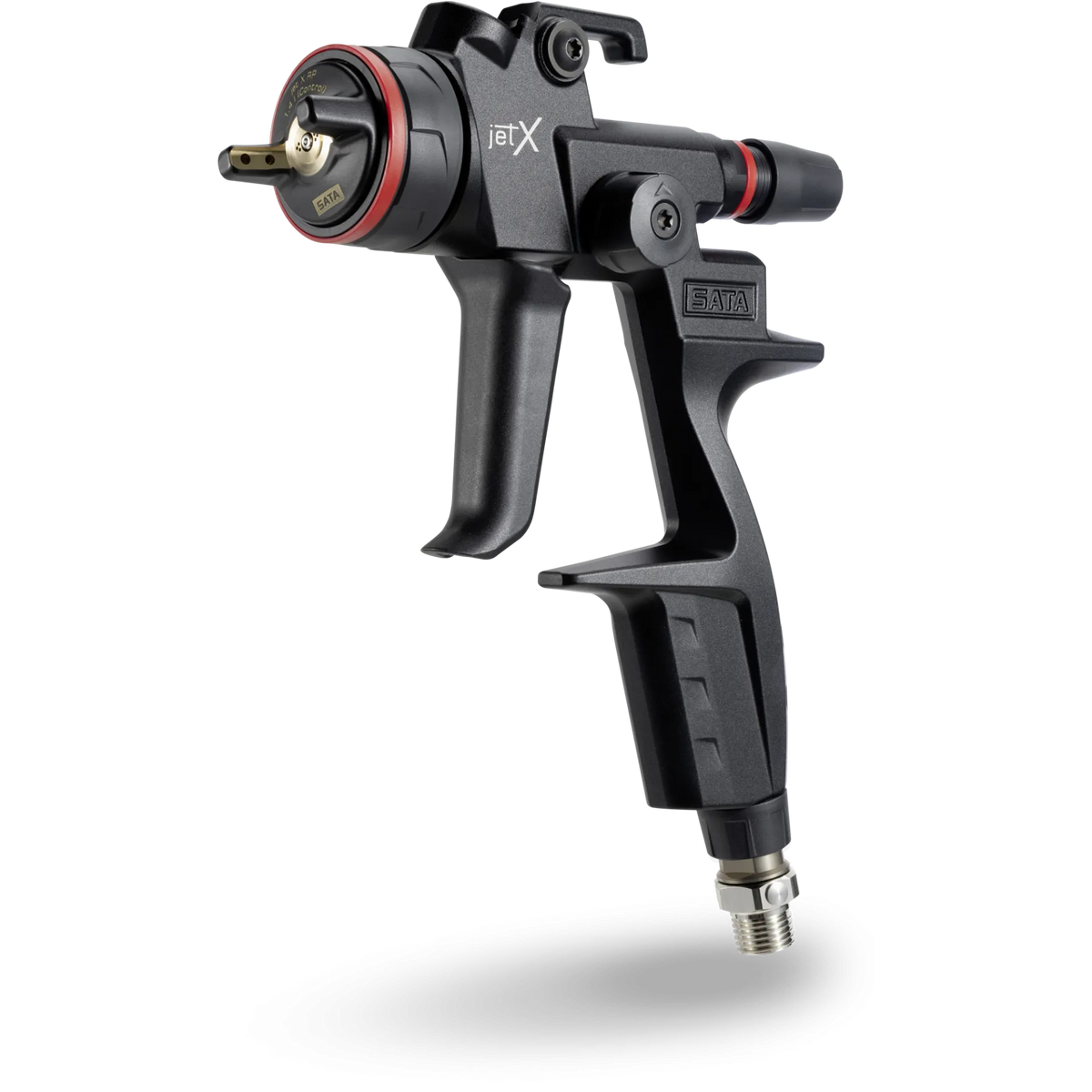
SATA product guideSATAjet X HVLP Spray Gun: specs, configurations and buying advice
SATA's current premium refinishing platform, combining the labyrinth airflow system, I/Control and O/Speed fan choices, and up to four digital-unit configurations. Build the gun around how you spray—not around the longest feature list.
SATAjet X HVLP Spray Gun: product overview
SATAjet X HVLP Spray Gun is a professional automotive refinishing spray gun for waterborne and solvent-borne basecoats plus 1K and 2K topcoat systems. This page covers the exact HVLP configuration with 1.4, 1.3, 1.2 mm nozzle sizing and I (Control), O (Speed) fan pattern in Digital Pro, Digital Ready, Basic, Digital form.
Who should buy it?Production refinishers who want SATA's newest premium atomization platform and current digital ecosystem.
Exact configurations and SATA part numbers
Use this table to confirm the exact SATA manufacturer part number before ordering a gun, nozzle set or replacement component.
| SATA part number |
Digital Version |
Nozzle Size |
Spray Fan |
UPC |
| 1201946 |
Digital Pro |
1.4 |
I (Control) |
4027533277439 |
| 1200245 |
Digital Ready |
1.3 |
O (Speed) |
4027533277354 |
| 1200237 |
Digital Pro |
1.3 |
O (Speed) |
4027533277347 |
| 1200211 |
Basic |
1.3 |
O (Speed) |
4027533277316 |
| 1200203 |
Digital Ready |
1.3 |
I (Control) |
4027533277323 |
| 1200188 |
Digital |
1.3 |
I (Control) |
4027533277293 |
| 1200170 |
Basic |
1.3 |
I (Control) |
4027533277286 |
| 1200196 |
Digital Pro |
1.3 |
I (Control) |
4027533277309 |
| 1200542 |
Digital Ready |
1.4 |
I (Control) |
4027533277415 |
| 1200287 |
Digital Ready |
1.4 |
O (Speed) |
4027533277392 |
| 1200261 |
Digital |
1.4 |
O (Speed) |
4027533277385 |
| 1200162 |
Digital Ready |
1.2 |
O (Speed) |
4027533277279 |
| 1200112 |
Digital Pro |
1.2 |
I (Control) |
4027533277224 |
| 1200097 |
Basic |
1.2 |
I (Control) |
4027533277194 |
RP or HVLP: which should you choose?
RP - choose speed and a familiar wet application
SATA's optimized high-pressure technology moves material quickly with VOC-compliant transfer rates and low overspray.
- Best fit for painters who prioritize production speed
- Longer recommended spraying distance on applicable SATA models
- Lower air consumption than the comparable HVLP setup on jet X/X 5500
HVLP - choose transfer efficiency
Low-pressure technology is designed for especially high transfer rates, putting more coating on the panel.
- Best fit when material efficiency is the priority
- Shorter recommended spraying distance on applicable SATA models
- Requires more air volume than comparable RP jet X/X 5500 setups
Simple answerChoose RP for speed and flexible handling. Choose HVLP when transfer efficiency matters most. Your booth, compressor capacity, coating system and local rules still matter.
Choose a nozzle size by material flow
| Size |
Good starting point for |
What changes |
Why choose it |
| 1.1-1.2 |
Lower-viscosity material, basecoat or painters wanting less delivery |
Lower material throughput |
Control-oriented starting point |
| 1.3 |
Basecoat, clearcoat and general refinishing |
Balanced delivery |
Most versatile starting point |
| 1.4 |
Clearcoat/topcoat or painters wanting a wetter pass |
More material than 1.3 |
Faster film build |
| 1.5-1.8 |
Higher-viscosity coatings where the gun and coating system allow |
Highest delivery in the range |
Check the coating TDS carefully |
Available on this page1.4, 1.3, 1.2
Your coating's TDS is the final authority. These are practical selection starting points, not a substitute for the paint, primer or clearcoat manufacturer's required gun setup, reduction and pressure.
I/Control or O/Speed fan?
I - Control
An elongated pattern with a smaller fade-out zone and drier core.
- Slower application speed
- Maximum control and easier placement
- Slightly less film build per pass than the same-size O nozzle
O - Speed
An oval pattern with a larger fade-out zone and wetter core.
- Higher application speed
- More film build per pass
- Best for painters who are comfortable managing a wetter application
What nozzle size does—and does not—changeWithin each jet X fan shape, SATA keeps the fan dimension consistent across nozzle sizes. Moving from 1.2 to 1.4 primarily increases material throughput; it does not simply make the fan wider.
Which digital version is worth it?
BasicNo digital unit. Lowest-complexity entry into jet X.
Digital ReadyPrepared for a retrofit adam X or adam X pro unit.
DigitalCompact adam X with inlet pressure, bar/psi and core operating information.
Digital Proadam X pro adds target-pressure alerts, operating data, tilt control and dashboard transfer.
Buy the version that solves a problemBasic sprays the same coating system. Digital improves pressure visibility and repeatability; Digital Pro is for painters or shops that will actually use target alerts, job data and the dashboard.
Technical specifications
HVLP technical data
Recommended inlet pressure2.0 bar / 29 psi
Pressure range0.5-2.4 bar / 7-35 psi
Air consumption445 Nl/min / 15.7 cfm
Spray distance10-15 cm / 3.9-5.9 in
What is included?The manufacturer evidence for the configurations on this page does not list a cup. Order the compatible SATA RPS cup system separately if needed.
Compressor check: Size the compressor for delivered air at pressure, not tank size alone. Leave operating headroom above the gun's stated air consumption and account for hose length, fittings, filters and other tools.
Which SATA gun belongs in your booth?
| Platform |
Primary job |
How you configure it |
Choose it when... |
This product SATAjet X |
Current premium basecoat/clearcoat platform |
RP or HVLP; I or O fan; four digital configurations |
Painters who want SATA's newest spray and digital ecosystem |
| SATAjet X 5500 |
Proven premium basecoat/clearcoat platform |
RP or HVLP; I or O fan; digital or non-digital |
Painters who want a broad, established premium setup |
| SATAjet 1500 B SoLV |
Solvent basecoat, sealer and clearcoat |
RP/HVLP and 1.3/1.4 choices |
A simpler, value-oriented solvent refinishing gun |
| SATAjet 100 B |
Primer, filler, UV primer and polyester spray filler |
Large primer nozzles plus dedicated UV/P configurations |
Preparation work—not a substitute for a finish gun |
Why pay for jet X or X 5500 over a 100 B?Because they solve different jobs. jet X and X 5500 are premium finish platforms for basecoat and clearcoat. The 100 B is a preparation specialist for primer and filler. If you meant the 1500 B SoLV, choose jet X/X 5500 for more configuration choice and premium refinement; choose 1500 B SoLV for a simpler solvent-focused setup.
SATAjet X HVLP Spray Gun FAQ
What is the SATAjet X HVLP Spray Gun best used for?
Professional automotive basecoat and topcoat work using the coating-compatible setup specified by the paint manufacturer's TDS.
Is HVLP better?
HVLP is the technology used by the configurations on this page. Review the RP/HVLP comparison above before choosing another platform.
Which nozzle sizes are available on this page?
The exact live configurations use 1.4, 1.3, 1.2 mm nozzle sizes. Confirm the SATA part number in the configuration table before ordering.
Does a digital SATA spray gun atomize better?
Digital pressure measurement does not change the core atomization by itself. It makes inlet pressure easier to see and reproduce; the nozzle technology, size, fan, coating setup and painter technique still determine application.
Can I interchange RP and HVLP nozzle sets?
Do not assume they interchange. Order the nozzle set for the exact SATA model, technology, size and fan pattern, and verify the manufacturer part number before purchase.
How large should my compressor be?
Use the air-consumption figure above as the minimum delivered-air requirement at pressure, then add headroom for pressure drop, duty cycle, filtration, hose and simultaneous shop demand.
Can this gun spray both waterborne and solvent-borne paint?
SATA positions jet X and X 5500 configurations for waterborne and solvent-borne refinish systems, but the coating manufacturer's current TDS remains the final setup authority.
Manuals and manufacturer resources
Before spraying: Confirm the coating manufacturer's current TDS, required nozzle range, reduction, inlet pressure, flash times and applicable VOC rules. If you are between configurations, contact PBE with the exact coating system and the kind of work you do.